
Key takeaways
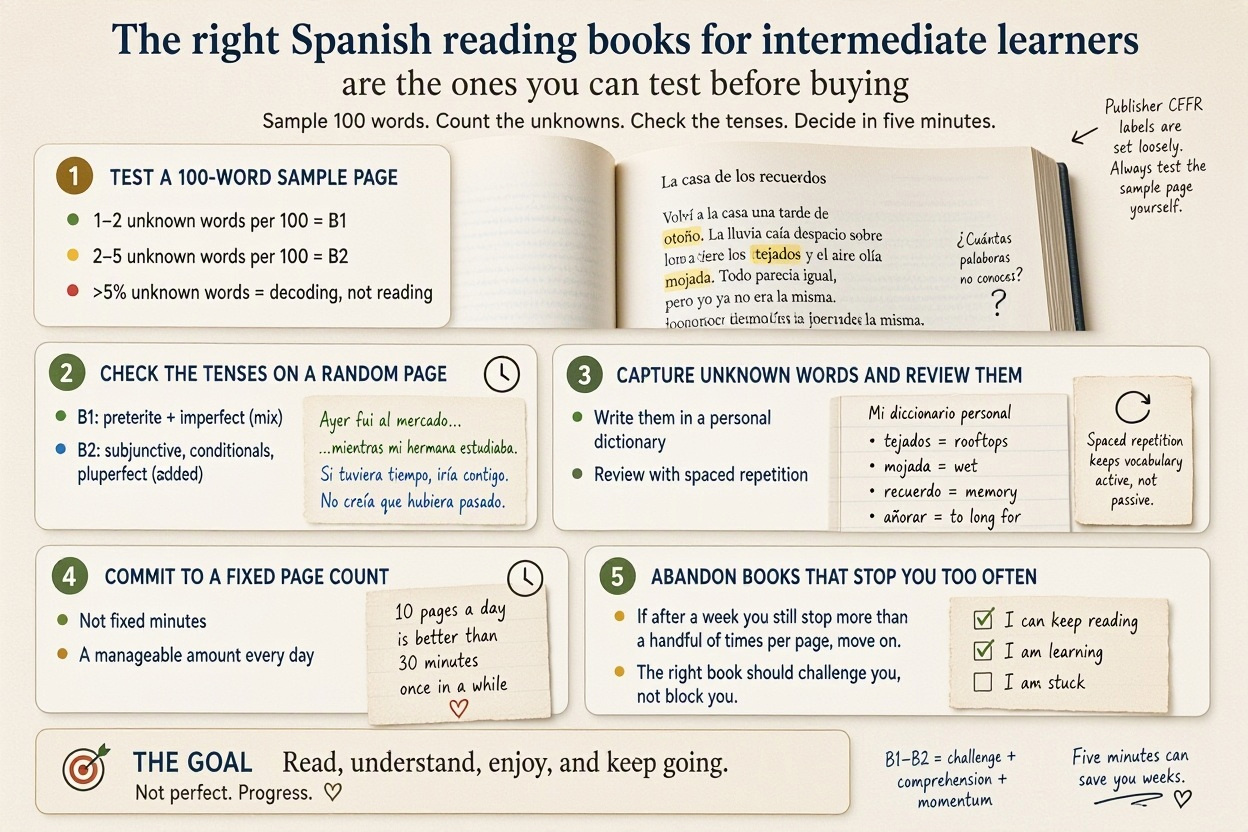
Test any Spanish book with a 100-word sample page: 1-2 unknown words per 100 suits B1, 2-5 suits B2, and above 5% the book becomes decoding rather than reading.
Publisher CEFR labels are set loosely, so always run the sample-page test yourself instead of trusting the level on the cover.
Check tense variety on a random page: B1 books should mix preterite and imperfect, while B2 books add subjunctive, conditionals and pluperfect.
Capture unknown words while reading into a personal dictionary and review them with spaced repetition, or the vocabulary stays passive.
Commit to a fixed page count rather than fixed minutes, and abandon any book that still stops you more than a handful of times per page after a week.
The right Spanish reading books for intermediate learners are the ones you can test before buying: sample 100 words, count the unknowns, check the tenses, and you will know within five minutes whether a book fits your B1–B2 level or will end up abandoned by chapter two.
How do you know if a Spanish book is at the right level for you?
Publisher labels tell you little. A book marked "B2" in one series can read harder than an unlabelled native novel. The reliable method is to test the book yourself before buying, using a sample page.
The five-minute sample-page test
Open any candidate book to a full page in the middle, not the first page, which authors usually write more carefully. Count the words you genuinely don't know, then check three things: how many tenses appear, how much of the page is dialogue, and whether you can follow the gist without reaching for a dictionary. Research on extensive reading suggests you need to know around 95–98% of the words on a page to read with reasonable comprehension and pick up new vocabulary incidentally, a threshold from Hu and Nation's coverage study, summarised in Paul Nation's resources. If the page fails those checks, the book will fight you for every paragraph. If it passes, tap any unknown words into your personal dictionary and let spaced repetition handle the review side — the workflow in Language In Use's library is built around exactly that loop.
Why publisher level labels mislead
Labels are set by editors, not by your vocabulary. Always run the sample-page test anyway.
How many unknown words per page is too many?
For extensive reading to work at your level, the ceiling is low. At B1, aim for no more than 1–2 unknown words per 100; at B2, 2–5 per 100 is workable. Above roughly 5%, you stop reading for meaning and start decoding sentence by sentence, which is exactly the habit that made earlier books feel like homework. The point of reading at B1–B2 is volume, and volume dies when every page is a puzzle.
Counting on a 100-word sample
Open any candidate book to a full page in the middle and count out 100 words. Mark every word you could not define without context, then check your total against this table:
| Unknown words per 100 | Verdict at B1 | Verdict at B2 |
|---|---|---|
| 0–2 | Read it | Read it |
| 3–5 | Too dense | Read it |
| 6–10 | Put it down | Borderline: try another sample page |
| 11+ | Put it down | Put it down |
Test two or three pages from different chapters before deciding, since dialogue-heavy scenes usually run easier than narration.
What to do when a book sits just above your threshold
A book at 6–8 unknown words per 100 is not wasted; it is a candidate for intensive reading instead. Read a shorter stretch, tap or look up every unknown word, and add each one to a personal dictionary you actually review. Tools like Language In Use are built for this: you collect the words from your reading and practise them with spaced repetition, so the harder book feeds your review rather than your frustration. Alternate it with an easier book so your daily pages stay at true extensive-reading density.
What tense variety should a B1–B2 page show?
Flip to a random page and mark every finite verb. At B1, the CEFR descriptor expects you to follow straightforward narrative, which in Spanish means preterite and imperfect doing the heavy lifting. At B2, you should handle main ideas in complex text, and that shows up on the page as subjunctive clauses, conditionals, and pluperfect mixed into the narration.
Preterite vs imperfect as a B1 marker
Count how often the narration shifts between habló and hablaba. If a page is nearly all preterite, it reads like a report and gives you no practice distinguishing background from event. A healthy B1 page shows both, ideally within the same paragraph.
Subjunctive density as a B2 marker
Look for cuando llegue, aunque fuera, no creía que estuviera. One or two per page is normal; a dozen signals dense, argumentative prose. If you can parse the shift without rereading, the book fits your level, and the tenses you flag become candidates for your personal dictionary, which is exactly what Language In Use is built to practise.
What genres work best for intermediate Spanish readers?
Genre changes the numbers in your sample-page test. Some structures give you predictable vocabulary and repeated plot cues, which lowers the unknown-word density you can tolerate without losing the thread.
Crime and thriller
Crime fiction suits B1–B2 because plot redundancy is high: the detective restates clues, suspects repeat alibis, and chapter endings summarise what happened. Dialogue ratio is also high, so you get conversational past tenses in realistic chunks. Expect more slang and police vocabulary than in other genres.
Memoir and biography
Memoir stays largely in the past tenses, usually preterite and imperfect, which makes it useful if your sample-page test flagged weak tense variety handling. Vocabulary is narrower than fiction: family, work, places, dates. The risk is long reflective passages with little dialogue, so check that ratio before committing.
Translated books you already know
Reading a Spanish translation of a book you know well gives you the strongest plot redundancy available. You already hold the story, so unknown words become guessable from context rather than blocking comprehension. Whichever genre you pick, tap unknown words into a personal dictionary as you go; the Language In Use apps sync that vocabulary across iPhone, iPad, Android, Windows and web for practice.
Should you use graded readers or native books at B1–B2?
Graded readers control vocabulary and grammar so you can read in flow, but at B1–B2 they can start feeling padded: you already know most of the words, so pages pass without teaching you anything. Native books give you real tense variety, real dialogue, and the satisfaction of finishing something an actual Spanish speaker wrote.
Where graded readers stop paying off
Run the sample-page tests from earlier sections on a graded reader. If unknown-word density drops near zero and every page recycles the same three tenses, the level label matters more than the reading itself. That is the signal to move up or out.
Bridging with parallel and bilingual texts
Parallel texts (Spanish on one side, English on the other) let you attempt native prose with a safety net, checking rather than translating every line. Tools like LingQ and Readlang do the same job digitally: tap any word, get a word-by-word translation, and build your personal dictionary from real books.
The honest self-test: whatever you read, the words you save need to come back to you. Whether a text is graded or native, if your saved vocabulary never reappears in spaced repetition or flashcards, the reading stays passive. That is the gap Language In Use is built to close, and the same criteria apply to it as to anything else here. For checking a verb form you met in context, the conjugation editor is one place to pin it down.
What formats (print, ebook, audio) support intermediate reading best?
Print suits slow, deliberate reading and margin notes, but every unknown word means putting the book down to reach for a dictionary, so lookups rarely become dictionary entries.
Ebooks and word-by-word lookup
An ebook reader with tap-to-lookup keeps you inside the story and feeds your personal dictionary directly. Tools like LingQ and Readlang are built around this: import a text, tap any word for a translation, and the word lands in your review queue. For a B1–B2 learner working through graded readers, series that label their levels against CEFR help you pick without guessing, so check how a publisher defines its levels before buying a whole series.
Audio-assisted reading for listening gains
Reading while listening to the audiobook trains the ear at the same pace as the eye, which matters because Spanish speech outpaces your decoding at B1–B2. Beelinguapp pairs texts with audio for this reason. The trade-off: audio slows re-reading, so use it for a second pass, not your first.
How do you turn reading into vocabulary you actually practise?
Capture while reading, not after
The notebook stage is where most reading routines die: you finish a chapter, face twenty new words, and copy out five before giving up. Capture at the moment you meet the word instead. Tap any word and it goes straight into your personal dictionary with its context and translation, so the graded reading and the SRS deck are one workflow rather than two projects.
Language In Use works this way on iOS, macOS, Android, Windows and the web, and everything core is free. You build the dictionary from books you are actually reading, then practise it in spaced-repetition games rather than re-reading a paper notebook.
Running the same sample-page criteria on your tools
Apply the unknown-word density test to your tooling too. LingQ, Readlang, Beelinguapp, Lexo and Lingueez all handle capture and review; the honest question is whether the deck you build gets practised or just accumulates. Ours included: if you import faster than you review, the dictionary becomes another abandoned notebook, only digital.
How do you build a daily Spanish reading habit that sticks?
Adult returners fail at reading habits because they design them around motivation, not logistics. Two structural fixes do most of the work.
Fixed page counts over fixed minutes
Commit to a page count, not a session length. "Two pages after lunch" survives a bad Tuesday; "thirty minutes" does not, because a hard page at B2 can take three times longer than an easy one. A fixed page count also makes progress visible in the book itself, which matters more than any app streak for learners who have already abandoned drilling apps once.
When to abandon a book
Run the unknown-word density test from earlier sections again after a week. If a page still stops you more than a handful of times, shelve it and start another from your rotation. Abandoning is not failure; a book you finish at B1 teaches more than a B2 novel you quit. Keep two or three books going at once so a bad night with one never stops the pages.
When you finish a session, add the words you tapped to your personal dictionary and let spaced repetition handle the rest. Tools like Readlang are built around exactly this read-then-review loop, and Language In Use does the same across iOS, Android, Windows and web.
What should you do when a book becomes too easy?
You finish a chapter, remember almost every plot point, and had to tap a dictionary fewer than once per page. Unknown-word density under roughly two per page, past tenses you parse without hesitation, and no new vocabulary reaching your personal dictionary: those are the signs the book has stopped teaching you anything.
Re-running the sample-page test on harder books
Apply the same three checks you used at B1: count unknown words on a random page, list the tenses you spot, and estimate dialogue. At B2, aim for three to five unknown words per page and at least two tenses beyond the present. If a candidate passes, read ten pages before committing.
Switching genres before switching levels
Level is not the only dial. Moving from a familiar crime series to journalism, literary fiction, or non-fiction raises difficulty inside the same CEFR band, because vocabulary and sentence structure shift with genre. That keeps your reading habit intact while the material stays demanding, and every new word still flows into the same practice loop.
FAQ
What CEFR level should a Spanish book be for an intermediate reader?
Aim for B1 or B2, but ignore the label on the cover. Publishers set levels loosely, so test the book yourself: read a full page from the middle and count the words you genuinely don't know. At B1, keep it to 1-2 unknown words per 100; at B2, 2-5 is workable. Above that, the book becomes decoding rather than reading.
Is reading Spanish books better than flashcard apps for vocabulary?
They do different jobs. Books give you words in context, with real tense variety and repeated exposure across chapters, which is how new vocabulary sticks. Flashcards handle the review side: a word you tapped once will vanish unless something brings it back. The strongest setup pairs them, so words captured while reading return through spaced repetition rather than piling up in a notebook.
How long does it take to finish a Spanish book at B1?
It depends on page count and density, not on any fixed pace. A hard B2 page can take three times longer than an easy one, so commit to a page count rather than a session length. Two pages a day finishes a 200-page book in under four months, and visible progress in the book itself beats any app streak for motivation.
Can I learn Spanish just by reading books?
Not entirely. Reading at the right density builds vocabulary and tense recognition fast, and audio-assisted reading trains listening too. But speaking and writing need separate practice, and saved words stay passive unless they reappear in review. Treat books as the engine of input, then feed the words you capture into spaced repetition so the reading compounds instead of evaporating.
Do I need a dictionary while reading in Spanish, or should I guess?
Both, depending on density. If a book sits at 0-2 unknown words per 100, guess from context and keep reading for meaning. If it runs denser, switch to intensive mode: look up every unknown word and add it to a personal dictionary you actually review. Guessing from a plot you already know, like a translated favourite, also works well.
Comments (0)
Be the first to comment.
Leave a comment